

Worldwide Pandemic Diaries
Worldwide Pandemic Diaries — Buenos Aires, Argentina



My name is Diego, I’m from La Matanza county, in the province of Buenos Aires. I work in a multinational company, one of the largest in Latin America, and almost by surprise and obligation have been working from home for more than 65 days. I have been in quarantine since before the isolation was obligatory, as a result of traveling to Brazil a week earlier. I was lucky enough to get home in time before the government decided to close the borders and become one of the 25,000 people left abroad.
Let me explain how we are dealing with the COVID-19 in Argentina: we have been in a preventative and mandatory isolation since March 19th. And with time, the nation has suffered gradual changes that depend on the situation of each state, taking into account the amount of infected people and the infection rates. There are close to 11,400 cases in Argentina and 445 deceased. Buenos Aires has the highest number of cases in the country. We also have 7 out of 23 provinces where we have no new cases.
All activities, other than those that are essential, must be approved by the national government as “exceptions”, and a permit to circulate must be acquired. Sadly, this situation includes strict air travel restrictions (all commercial flights are prohibited to Argentina until September 1, 2020). In order to travel or stop over in Argentina again, two things must occur: the government must lift the restrictions and the World Health Organization must approve of the travels – it seems that neither will happen soon. I heard some rumors that during the next few days internal flights will return only between provinces that do not have infections, in order to help the tourism sector, which has been heavily affected.
Since Tuesday, May 26, traffic in Buenos Aires has been reinforced with road control points – – the objective has been to slow the circulation of unnecessary and nonessential people using highways and other means of transportation. These reinforcements have affected trains, personal vehicles, public buses and the subway. Specifically with the train and subway, there is a limit on the number of people that can ride at any given time, and only half the number of train and metro stations are open. All previously federally granted transit permits were revoked over the weekend in accordance with the new regulations.
Argentina’s quarantine would seem to be about to enter the history books. It is going to become the longest confinement in the world, surpassing the one carried out in Wuhan, China, at the beginning of the outbreak of the pandemic. At this moment there is a discussion in the media, and therefore among the people, about the economic impacts of such a long quarantine. I understand the need to discuss these issues and I think it is important to seek a balance between health and our economic future. From my perspective, I would say that this is an out-of-time discussion because the pandemic does not seem to be over in our region, and the future seems to be uncertain. The results, if any, will be seen at the end of the road.
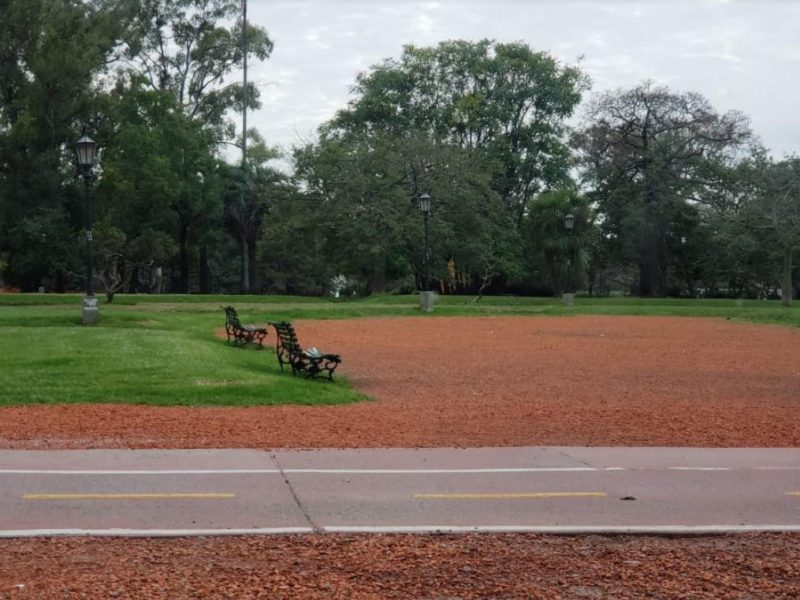
Empty park in Buenos Aires
This week, we celebrated the “25 de Mayo” (Homeland´s Day) to commemorate the 1810 revolutions. In a normal scenario, taking advantage of the holiday, many families gather and eat traditional dishes. This year it was a different festivity, connected by video calls and confined in our houses.
I am very convinced that in the end, we will learn from this experience, to take advantage of it, to rebuild a more humane, more supportive, more grateful world, where we are stronger.
Stay home and take care of your people!!
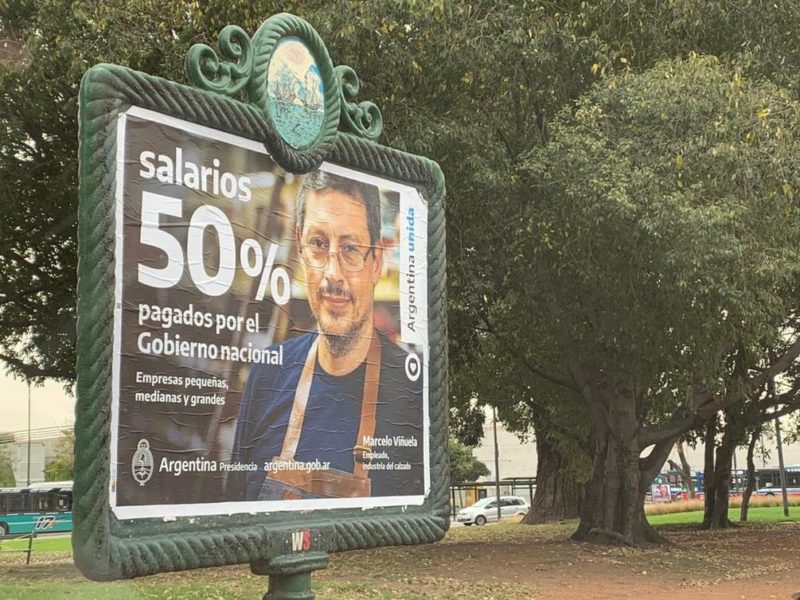
This sign reads “50% of salaries paid for by the national government. Small, medium and big businesses.”